Friday, April 29, 2011

Mom's Cookbook: A Retrospective

How many sculptures did Michaelangelo create? Answer: 31. How many songs has Dolly Parton claimed to have written? Answer: 5000. How many paintings did Picasso create? Answer: about 13,500.

Art -- whether it be painting, sculpture, music, architecture -- should be able to stand on its own. That is to say, a piece of art should be engaging all on its own, whether or not you know any details about the artist or when, how, or why it was created.

For example, I'm betting that we all first saw Van Gogh's "Starry Night" long ago, before we knew anything about Van Gogh, art theory, or post-impressionism. My first encounter with the piece was at my best friend's house. A reproduction was hanging in the living room, and I remember staring at it and having a visceral reaction to its dark, moody composition. Justin's mother told me that it was a famous painting by "Van Go" called "Starry, Starry Night," and I immediately declared it to be my favorite painting. I was eight years old.

"Starry Night" by Vincent Van Gogh


It wouldn't be until high school that I would learn more about art theory, and how different painters belonged to different art movements in history. Along with this new information, came a new and deeper appreciation of the work.

But it wasn't until my art survey classes at USC that I learned more about the life of Vincent Van Gogh, and how his art developed through the course of his life, all the way up until his death by suicide. To see the development of his use of color, and texture through the use of his brush strokes was to know the very story of his life. How was it that I had loved this painting my whole life and only now was I learning that he had painted it while he was in an asylum? How much more did I now love this painting knowing that it was part of a series of Starry Sky Paintings? (It was like discovering Starry Night had long lost cousins!)

"Starry Night Over The Rhone" by Vincent Van Gogh


Though Starry Night definitely stands on its own as Van Gogh's magnum opus, knowing all of the details of Van Gogh's life and development as an artist helps to bring the artwork into focus, and provides a lush depth to our understanding and appreciation.

If I took a poll of the general public and asked, "Which composer do you love more: Mozart or Beethoven?" I'd be willing to bet money that Mozart would win by a landslide. Both were geniuses -- of that, there's no doubt. Both were prolific composers, and both began composing before age 10, and both composed right up until their respective deaths.

Wolfgang Amadeus Mozart vs. Ludwig Van Beethoven


But if Mozart is the more popular (IE. "more pop"), it's precisely because his life was perhaps less extraordinary than Beethoven's. Sure, if you've seen the movie "Amadeus," then you know that he had some daddy issues and was buried in a pauper's mass grave... But compared side-by-side with Beethoven's life, on whole, Mozart led a pretty boring life. Similarly, if you compare their respective bodies of work side-by-side, you'll undoubtedly see development and (sometimes daring) innovation, but it's Beethoven's life/work that is filled with pathos and drama. Did you know that Beethoven's 9th symphony (known as "Ode To Joy") was composed when he was 54 years old, nearing the end of his life, and was at that point completely deaf?

The idea that art, in all its forms, stands alone and in the context of its history is not a new one. (I'm just not that original.) But you don't have to have a formal education to be able to observe this kind of evolution, as contemporary examples are all around us. If you're familiar with Michael Jackson singing "ABC," "Billy Jean," "Thriller," and "Man In The Mirror," then you've witnessed the evolution of this artist first hand.


Okay, so now let's talk about food.

I think that most people will agree that food and cooking can be elevated to the point of being "art." Indeed, my degree from The Culinary Institute of America was in "Culinary Arts."

You don't need to be a great "artist" to paint. And yet, we generally accept that if you (the everyday schlub) paint something, it's automatically "art." If we extend this idea to food and the culinary arts, then isn't it fair to say that you don't need to be a great chef to create "art" out of food? Furthermore, if every painting, great or not, is art, then isn't every dish we cook or create also art?

Stay with me on this...

If every dish you cook or create is art, then you should be able to examine everything you ever cooked in your life as part of a larger body of work -- just like the collected works of Beethoven or Van Gogh.

Surely, you would see that your tastes and food preferences change over the course of your life, along with your technical cooking skills. But it would also reflect where you lived at different times of your life, who your friends were, what the food trends were, and even the social politics of the day. If you grew up in Kansas, but then went to college in Los Angeles, did you learn to make tamales and California rolls? If you lived through the 1950s and 60s, did you have a go-to aspic/Jell-O mold that you made for parties? Or maybe at some point you found yourself living in the Napa Valley and jumping on the organic / sustainable / local bandwagon?

So, of course, this got me thinking about my own life's cookbook as a reflection of my life story. What would be the first dish, the first thing I ever "cooked?" Well it wasn't really cooking, but my bet would be that the first page of my cookbook would be something like celery sticks with peanut butter from around the time that I was 7 years old.

But the one thing I'm pretty sure of, is that the first thing I really cooked (ie. using heat on the stove) on my own is Kraft Macaroni and Cheese out of the box. I was about 9 years old. The directions were pretty simple (to read and to follow), and all I needed was a chair to stand on at the stove. I remember following the directions to the letter, including "fill a saucepan with 8 cups cold water." It's funny to think that I measured out that water so carefully, as if a little bit more or a little bit less would ruin the dish!


I became pretty proud of my Kraft Macaroni and Cheese, and after awhile, I started to vary the directions a little. The directions said to boil for 7 1/2 minutes, so what would happen if I boiled it for 8 or 9 minutes? Ah! I see... the texture of the macaroni is too soft! Does it matter what order I add the milk, butter, and cheese sauce powder into the macaroni? (The answer is yes -- the cheese sauce powder tends to clump more if you add it first, and it's harder to stir it into a smooth consistency.)

In retrospect, I see that I was just like a little painter, painting the same landscape over and over again, perfecting it, and then experimenting with variations of it.

I wish I did have such a cookbook of my life. I'm curious to know what was the first thing I cooked in my first apartment? (I bet it was something like Cup-O-Noodles.) Or what I cooked after that devastating car accident that almost killed me and left me with a broken arm and barely able to walk. (I bet it was something like Cup-O-Noodles.) What did I cook after I got my first job that paid $1000 a week? (Probably something like Cup-O-Noodles and a rib-eye steak.)

My life's cookbook won't really be completed until I die (or become so invalid that I can't cook anymore). And because context is everything, I think now I'll be more cognizant of not just what I'm cooking, but also why I'm cooking it.

For instance, tonight, I'm cooking Chicken Kiev (using a grand cru butter called Celles Sur Belle), Joël Robuchon's pommes purée, and fennel braised in butter and orange juice. And the context? Well, it's because it's my turn to host ManDinner, and tonight's theme is "butter!"

Aside from my own life's cookbook, I wonder even more about what my mother's cookbook would look like. My mother is one of the greatest culinary influences of my life, and I know full well her greatest "compositions" ("Bravo! Bravo, Mom! Can I have some more, please!!") and her worst, barely edible art ("No, thanks, Mom... I'll just have some Cinnamon Toast Crunch cereal for dinner.").

Born in 1943, Mom grew up in the Philippines in the 1950s. In America, it was the setting for the TV series "Mad Men," and though it was quite different in the Philippines, somethings were definitely the same. Mom has told me about the Home Ec classes that she had in school, and they were definitely boot camps for the housewives of the 50s and 60s. Consequently, I recall being very young -- four or five years old -- and watching my mother make (from scratch) creme caramel custards, and angel food cakes iced with buttercream frosting. She would effortlessly decorate cakes with pink buttercream roses, complete with green leaves and stems.

Mom in Chicago, May 1968, at a baby shower thrown by her friends. She was six months pregnant with me. (And that's not one of her cakes -- it's too plain looking!)


Around the time I was 9 or 10 years old, Mom started exploring the culinary traditions of different cultures. If Pablo Picasso had his Blue Period and Rose Period, Mom had her American Period, Mexican Period, Italian Period, and Japanese Period.

Before the American Period, Mom and Lola (my grandmother who lived with us) cooked Filipino food almost exclusively. And so, when I was about 9 (I don't remember exactly), it was with great anticipation that Mom, all by herself and without anyone to show her the way, cooked her first Thanksgiving Dinner.

Yes, I can hear you chuckling -- and rightly so. Thanksgiving Dinner, as we all know, is a challenging endeavor. And let me just remind you that there are no turkeys in the Philippines. But Mom eventually became a pro, and after a few years, her Thanksgiving Dinner was indistinguishable from Mrs. Jones' of East Coast Joneses.

Well, except for that one year where she decided to experiment a little.

Again, I don't remember the exact year, but I think it was sometime in my late 20s. In a lot of Asian cultures, when roasting a pig, it's often stuffed with really aromatic ingredients like lemongrass and ginger. Well, Mom thought she'd try it in a Thanksgiving turkey one year. It wasn't bad, mind you, but it just wasn't Thanksgiving. I just remember my sister and I being able to smell the Turkey from five feet away, and just standing there and staring at it.

Equally, as disappointing was Mom's first attempt at Linguine with Clams (Italian Period, c. 1981). I recall the "sauce" to be more like salty water, and not being able to get the wet linguine to stay on my fork. The only way I could get traction on the damn noodles was to heap on tons of Kraft Parmesan Cheese from that green cardboard can. (And don't even try and pretend that your family didn't always have it on hand, too.)


Now, lest I give the impression that Mom was a bad cook, let me just tell you right now: she's not. She would eventually go on to perfect all the dishes she attempted, and she's one of the most versatile cooks I know. It doesn't matter if you're talking about Thai spring rolls, fire-roasted Mexican salsa, or Italian lasagna -- she can outcook everyone I know, including myself.

These are just a couple of examples of her growing, experimenting, and generally finding her own way. As a self-taught cook, keep in mind that she was a mother of four young children, with a full-time career. Honestly, I don't know where she found the time. But watching her grow as a cook helped to foster my passion for food and taught me to try different things without fear of failure.

If it were only possible to collect everything my mother ever cooked into one giant cookbook! Imagine, you'd be able to see the evolution of the failures into the defining dishes that they are today (as Mom's lasagna was not always so). And I wonder, what was the first thing she ever cooked for my Dad? Did she try to impress him with something fancy, or did she go for some sure-fire comfort dish? What was the first thing she cooked after her mother passed away? Was it one of her mother's dishes that reminded Mom of her?

Through the dishes that she cooked everyday, you'd be able to see the good days and the bad days. You'd see the Philippines, New York City, Chicago, and Los Angeles. You'd see every decade from the 1950s to the present. You'd see the lean days of an immigrant in a foreign land, as well as the prosperity of a successful American professional. You'd see her as a daughter, a sister, a friend, a girlfriend, a wife, a mother, and as a grandmother. In short... you would see her whole life.

Oh, and by the way, with respect to this blog post... Today is my mom's birthday. How's that for context?

Friday, April 8, 2011

The Signs Of A Woman


For years, I've kept a basket in my living room, and if you've ever left anything behind at my place, chances are you can find it in what has been affectionately named "The Ho's Lost-and-Found." If you know me well, you know that most of my friends are women. But even if you don't know me well, it shouldn't be a surprise to know that it's women, more so than men, that tend to forget and leave things behind. In The Ho's Lost-and-Found you'll find everything, including phone chargers, hair clips and ties, lipsticks and lip balms, sunglasses, wallets, watches and jewlery, and various articles of clothing. The articles of clothing are everything you can think of including skirts, shoes and gloves.


When I find something that has been left behind I always put it into the lost-and-found -- but, usually not for a day or two. Instead, I like to leave it right where it is for awhile.

If, in the morning, I find a pair of your earrings on the coffee table, I'm likely to leave it there for the rest of the day -- right next to the lipstick stained Champagne flute that you were sipping from the night before.

I love the sight of it as a reminder of our time together.


It might be your Gucci watch that you left on the bathroom counter, or it might be the fancy hair clip you put on the table behind my couch when you pulled your hair down. Seeing it the next day helps to evoke a stronger emotional memory, and for a few seconds, winds the clock back a few hours.

But sometimes, the things that I find in my apartment are from times that I'm not even around. These little tableaus are my most favorite!


I love seeing the signs of a woman -- the signs that let me know that she was there. But maybe even more so, I love the way it makes me wonder about what she might have been doing while she was alone. I think women are wonderful and mysterious creatures and for some reason I find even their most mundane to be fascinating.

Many years ago, I lived with my (now ex) girlfriend, Lisa. There were times that we had opposite work schedules, and as a restaurant manager, it wasn't uncommon for me to come home at 1am and Lisa would already be in bed, asleep. But in the couple of hours I needed to unwind before bed, I'd find all kinds of clues of Lisa's evening without me. I remember once that I found her red Dansko clogs (she was a pastry cook and red was her favorite color) in the middle of the hallway. That's odd, I thought. She didn't take them off at the door, or maybe in the bathroom while she was undressing... she took them off right in the middle of the hallway? And then I realized that I was standing in front of the heater in the hallway. She must have kicked them off seconds after she came home and, as she often did on cold nights, warmed herself in front of the heater. Thanks to her red clogs, I could see it even though I hadn't been there.

That was about seven years ago.

Most recently, my friend, Hadley, came to live with me for the month of March while she attended the Wine Immersion program at the CIA Greystone campus. More than a decade earlier, Hadley’s oldest sister, Bijou, was my classmate in culinary school at the CIA in Hyde Park, New York – so that’s how I know Hadley. She comes from a family of foodies and wine lovers (and her family owns a winery in Idaho), so it’s no surprise that we got along famously.

But before Hadley arrived, I have to admit that I was a little worried. I hadn’t lived with anyone in such a long time… my gut was that this was either going to work out great, or it was going to be a disaster.

Thankfully, it wasn’t a disaster.

Hadley ended up being exactly what I needed in my life at the moment to break the monotony of my routine. She’s active and upbeat. She got me brushing up on my wine knowledge with her afterschool questions. Her smile never failed to brighten my day, and it was nice to hear the sound of a woman singing while she studied. And while it might seem odd to some (but not so odd if you know me), I really loved doing the housekeeping for someone else. I also loved having to take someone else into consideration on a day-to-day basis… Like I said, it had been a long time.

But I digress…

Living with Hadley was great, and I liked seeing evidence of her around the apartment: Greek yogurt in the fridge, her Macbook on the dining table, her Specialized bike chained to the post next to my parking space. But my favorite reminders that she was living with me were the personal things that were symbolic, not just of her presence, but of her femininity: her shoes in the living room, her hair ties or the corkscrew shaped bobby pins, her rings on the bathroom counter.

Again, sometimes it’s about finding things and picturing the moment they were set there.

One day I came home to find Hadley’s earrings on the kitchen counter, right in front of the basket where we kept different loaves of bread. It was about 5:30pm and she wasn’t home. I knew that she got off school about 4pm, usually got home about 4:30pm, and then would often go to a yoga class or ride her bike to the Oxbow market to sit and study over coffee or a snack. But sometime between getting home and leaving for wherever she had gone, she had taken her earrings off and put them on the kitchen counter.

Maybe she had taken them off in another part of the house, gotten distracted doing something else, and set them down as she walked through the kitchen? Or maybe she was nibbling on a piece of bread from Tartine Bakery, when her mobile rang, and she took the earrings off because of the way they rub when she’s on the phone? It didn’t really matter – I just loved the sign Hadley had left behind that she had been there.

Another time, I woke up on the weekend in the early afternoon. Hadley had gone off to Point Reyes to ride with some friends. I found a rinsed off plate and coffee mug in the sink, one of the dining chairs pulled out, and this months’s Elle magazine sitting askew on the table. I imagined Hadley sitting there with the morning sun at her back, nibbling on toast and flipping the pages of the fashion magazine. The thought of it made me smile.


Hadley left on April the 5th, back to her life at the family winery in Idaho. The month had flown by, and she had taken her final wine exam. I was sad to see her go. But even as we said our goodbyes in the parking lot, I anticipated (and was even comforted by the idea) that she had probably left something behind.

When I went upstairs, I started looking around. Would it be her shampoo and razor in the shower? Nope. Would it be a hair tie on the nightstand? Nope. Maybe one of her rings in the pocket of the bathrobe I had lent her? Nope.

Hadley was an experienced traveler, and as such, I realized, she was too conscientious to leave anything behind. Indeed, there wasn’t even any cleaning up left for me to do -- she had even laundered her sheets and taken out the trash from her wastebasket. She hadn’t left anything behind, and there was hardly a trace that she’d been there at all.

I was kinda sad the rest of the day, and I missed the sound of Hadley’s voice, her smell, her stuff in the bathroom. I missed her presence.

And then, at about 10pm that night, I went to the bathroom to brush my teeth. And as I brushed away, I looked down, and in the sink I saw two long strands of ginger colored hair. My heart warmed, and I was careful as I spit and rinsed. I didn’t splash her hair with water, I didn’t wash it down the sink. I left it just as was it was for a day or two.

Tuesday, March 1, 2011

If You Had To Choose Your Last Meal, What Would It Be?


"If you had to choose your last meal, what would it be?"

I can't recall the first time I tried to answer the question, but it's one I've asked myself over and over for many years. I'm sure I was a kid in school when I first heard that condemned men were always given a last meal of whatever they wanted. As a kid, who knows what I would have said? Pizza? Hamburgers?

I remember being in my 20s and occasionally hearing about someone in prison who was about to be executed. That kind of thing seemed like it was bigger news back in the 1990s. It seems to me that, as a nation, we were struggling with the constitutional and ethical questions surrounding the death penalty.

Back then, I didn't know yet that I was a "foodie" -- indeed, the term wasn't part of the common lexicon yet. But in much the same way that parents of gay children can look back and point out specific examples of their kids' "gayness" at a young age, I too, can point out my reaction to the news that someone on death row was about to be executed: I'd feel sad for the poor guy for a few seconds, and then I'd wonder what he was going to have for dinner.

Can they really have anything they wanted? What if they wanted, like, I dunno... 50 lobster tails? Was there a cost limit? What if they wanted something super exotic like Chinese bird's nest soup? Would they have to postpone the execution until they could get it? What if you asked for a particular chef's signature dish? Could Wolfgang Puck be compelled by the state to make a condemned man's last barbeque chicken pizza? Could you really ask for anything?

These might sound like cheeky questions, but remember, I was just a kid and this was long before the Internet. I really did wonder about these things! And the questions drove me crazy, because it's not like I could go to the card catalog at the public library and just look up "Last meals for the condemned."

But being obsessed about the idea of a last meal was more than morbid curiosity. Without having to even ask the root question of "Why is it important to grant the condemned a last meal?" I thought I intuitively understood the reasons and implications behind the tradition of offering a last meal to the condemned.

"Well, obviously, it's granting the condemned a last, but profound, comfort before being executed." Apparently, I'm wrong about that. According to Wikipedia, accepting a last meal symbolizes a coming to terms (IE. a kind of forgiveness or absolution) with those who are about to chop your head off.

I've also since learned that there are general restrictions on the condemned's last meal, and that the restrictions depend on the state where you're being executed. Some states put a limit of $40 on the meal (Seriously? That's my bar tab when I'm drinking... alone.). And some states limit the request to the food already available within the prison system, while others allow you to order things like Domino's pizza or roast beef sandwiches from Arby's.

But back to the question... What would you have as your last meal?

Wikipedia lists a several last meal requests that have been made in the past, and it appears that steaks and lobster tails are pretty popular. But, interestingly, some of the condemned have used the opportunity to make a personal statement.


"Joan of Arc: [requested] Holy communion."

"Odell Barnes: [requested] 'Justice, Equality, World Peace.'"

"Philip Workman: He declined a special meal for himself, but he asked for a large vegetarian pizza to be given to a homeless person in Nashville, Tennessee. This request was denied by the prison, but carried out by others across the country"

"Victor Feguer requested a single olive with the pit still in." (I have no idea what that means.)

"James Edward Smith requested a lump of dirt, which was denied. He settled for a small cup of yogurt"


One thing is for sure, though: You can count on me not to use my last meal to make a statement. And I wouldn't use the opportunity to indulge in expensive caviar, lobster, and foie gras, either. No, I think I would want my last meal to be comforting, calming, and delicious.

But what's the most comforting and calming thing I could eat?

There's a short list of things that might fit the bill (and, yes, a McDonalds Big Mac and fries are on that list), but over the years, I've come to realize that there's only one dish that I would want on my last day alive: my mother's Filipino chicken adobo and steamed rice.

This is the one dish, above all others, that comforts me the most. I would have to guess that, as a kid, we had it every couple of weeks. It was good hot, warm, or cold. It sated completely, and paradoxically, created a craving for itself.

And the memories that go along with the dish? They're cumulative.

The pungent and savory aroma of vinegar and soy sauce simmering takes me back, simultaneously, to every moment of my childhood. That is to say, it reminds me of being 6 years old as much as it reminds me of being 16 years old. It reminds me of summer lunches as much as it reminds me of winter dinners. How can a dish do that?!

It only has five ingredients: chicken, vinegar, soy sauce, black pepper, and bay leaves. And yet, these simple ingredients transform... and then transcend.

Chicken adobo and rice is the food of my family... the food of my childhood. No matter where and when, eating it reunites me with my family. If I were condemned and about to be executed, this is the food that I would choose as my time machine to instantly transport me back to a time long ago and transform back into the kid that is my mother's son, the kid that is the big brother to my two younger sisters and my baby brother.

Is it trite to think that there is a food that could represent the innocence of my childhood?

Maybe.

But if this atheist foodie were about to be executed, it's all I would have left.

Saturday, February 12, 2011

The Peanut Butter, Nutella, and Banana Sandwich


The world of sandwiches is wide and varied -- everything from BLTs to hamburgers, and hot dogs to pitas (yes, hot dogs are sandwiches). And you can use Venn diagrams all day long to break sandwiches down into a multitude of categories and sub-categories. But when it comes to the sandwiches I make at home, I tend to think of them as either meal sandwiches or snack sandwiches.

The difference between meal sandwiches and snack sandwiches mostly have to do with the size (or "heft," as I like to say when I'm feeling spry), sweetness, ingredients, and amount. It's not a clearly defined set of rules, but rather a bit like porn -- I know it when I see it.

A grilled cheese is a snack sandwich. Double roast beef with avocado, sliced onions, and triple mayo is a meal sandwich. Peanut butter and jelly is a snack sandwich. Hot dogs are both a snack sandwich AND a meal sandwich, depending on if you're having more than one. If you're just having one hot dog (even if it's fully loaded), then it's just a snack as far as I'm concerned.

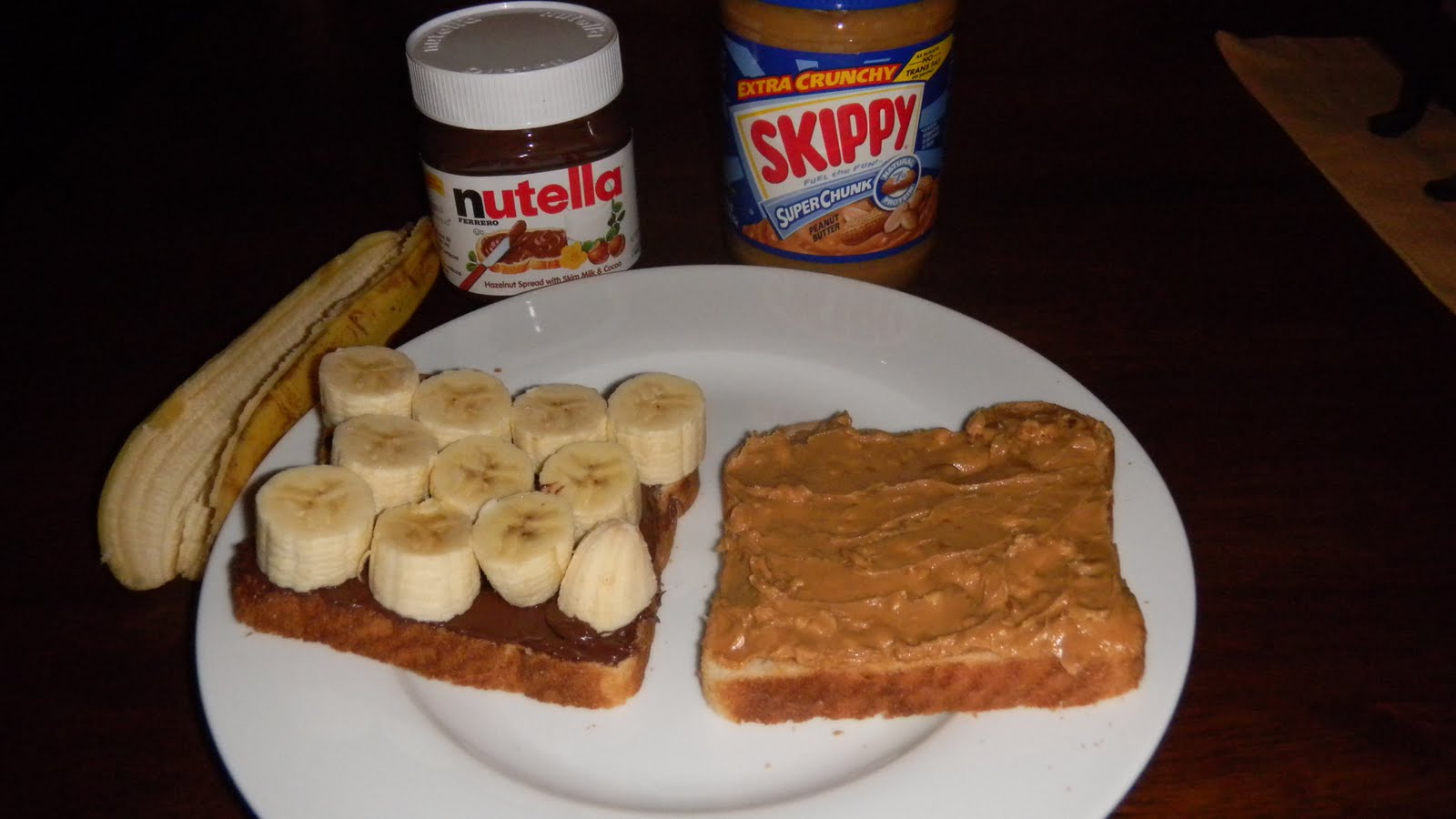
Okay, so let me tell you about my favorite snack sandwich. You start with two slices of white bread, slather one side with Nutella, slather the other side with crunchy peanut butter, and stick slices of banana in between.

Sounds awesome, right? The soft white bread is the perfect porous canvas for the two spreads. And, yes, you have to use crunchy peanut butter to texturally offset the soft and gooey texture of the other ingredients. Chocolate, hazelnuts, peanuts, banana... It's sweet, savory, and fruity all at the same time!


I can't remember when I started making these sandwiches, but I know I've been making them for over 20 years. As far as I knew, I was the only one making them, and to this day, I don't personally know anyone else who makes them. Now, I'm not saying that I "invented" this sandwich or that I was the first person to ever throw this combination together. But what I am saying is that no one taught me this sandwich. I came up with on my own, and as far as I know the sandwich doesn't have a name other than simply rattling off the ingredients.

I Googled "banana nutella peanut butter sandwich," and only found a few examples of other people making this sandwich. (One fool took the extra step to grill the sandwich. I'll keep an open mind and try making it that way someday, but I don't think I'll like it grilled.) Furthermore, and again, there doesn't seem to be a name for the sandwich. This leads me to believe that it's not an "official" or widely made sandwich.

I think I should try to come up with a cool name for it. I don't want it to have a goofy name like "fluffernutter," and I certainly don't want it named after me or anything like that. But... I gotta come up with a name.

Monday, January 10, 2011

Dreaming of Chassagne-Montrachet

Last night, I went to bed early... way too early. I was playing Call Of Duty: Black Ops when I started to feel a little hungry around 7pm. In between games, I scuttled back and forth to the kitchen, cut shallots, measured cups of rice, selected bay leaves, and opened chicken broth to whip up some rice pilaf. I had a USDA choice porterhouse steak in the fridge, and after the rice was done cooking, I took a break to make the steak. I planned on playing Call Of Duty for a few more hours, so I didn't open any wine (lest I dull my reflexes). Instead, I washed it all down with bottled water laced with Emergen-C powder.

Within an hour, I was feeling sluggish, then sleepy. I've noticed lately (ie the past couple of years) that eating a lot of rice makes me sleepy, and I suspect that it might be the precursor to diabetes. The heavy carb load overwhelms my system and I go into a food coma. I know some would say, "Well, dummy, if you know that, then why don't you just eat a smaller portion of rice?" Yeah, right. Instead, I fell asleep on my couch from 8:30pm to 3am. (So I guess when I say that I went "to bed" early," I mean "my couch.")


Most people find sleeping on my couch very comfortable, but I don't -- not compared to my pillow-top king-sized bed and down feather pillows. The initial discomfort lead to a weird dream: Danny Trejo, impersonating a police officer, pulled me over in a residential neighborhood for speeding. I had a suspicion that he wasn't really a cop because he was driving a Toyota Celica that had flashing red and blue lights on the dashboard. When he asked me for my licence and registration, I asked to see his badge. He quickly made some excuse, and then sent me on my way.

I woke up, uncomfortable because I couldn't splay out like I usually do in bed. But I was still sleepy enough that I couldn't be bothered to actually get up and go to my real bed. So I flipped over a couple of times, tucked my arm under my head, and got comfortable enough to fall back asleep. This led to my second dream.

Well, it wasn't so much a dream as it was a re-living of an evening from a few weeks ago.

Emily and I had just had dinner at the bar at Bottega in Yountville, and now we were back at my place sitting on the couch. I asked, "Red or white?" and she said, "White." I was delighted at the chance to open something white, because about 90% of the time, people opt for red wine. "Hey, is it okay if I open some white Burg?" I pulled my last bottle of 2003 "Tete de Cuvee" Chassagne-Monrachet from Verget.

I opened, poured, smelled, swirled, and then smelled again. From that moment, our little get together was instantly transformed into a memorable event.

"Oh, wow..." Emily said after deeply inhaling the wine.

She was sitting sideways at the end of the couch, snuggled into the corner pillows, with her legs tucked to the side. Her eyes closed for a few seconds after her first sip, searching for words, it seemed. But then her eyes opened and she just smiled. "Mmmmm," seemed to sum it all up.

"Oh my god," I said. "This is what chardonnay should be." Emily nodded.

My pronouncement, though, was more than a comment on the fact that I really liked this wine. I was expressing the fact that it was a seven year old chardonnay from Chassagne-Montrachet made in a style that, in my mind, is the antithesis of the California style.

When most Americans think of chardonnay, they think of young wines not more than a couple of years old. As a rule, we don't age chardonnay in this country. Indeed, most Americans don't even realize that chardonnay can be aged. I recall a day a few years ago when I was still working at the restaurant at Domaine Chandon, and one of the servers alerted me to a bottle of Chablis a guest had brought in and wanted me to open. "It's like three years old," the server said with a laugh. "You mean it's only three years old," I said, and she just gave me a confused look.

If you put my feet to the fire, I'll readily admit that Chassagne-Montrachet is my favorite region for chandonnay. Even though Puligny-Montrachet is considered more prestigious, I favor the fuller, more feminine style of Chassagne-Montrachet. This especially holds true when I compare the two regions through the lens of an older wine: I find that the bigger, more concentrated fruit in Chassagne-Montrachet helps to balance the acid in wines more than a few years old. (By the way, when I use the phrases "fuller style" or "bigger, more concentrated fruit," I'm not talking about anything approaching the California versions of those terms! I use those terms to describe the relative differences within white Burgundy.)

Anyway, back to this wine...

This 2003 Chassagne-Monrachet from Verget exhibited superb balance and elegance. Ripe (almost baked) apple, honey, almonds, and a touch of toast on the nose danced against the subtle minerality. The round acids in the background balanced freshness with maturity. The body was the perfect weight, the mouthfeel was the perfect silkiness sans unctousness.

So, yeah... that's what I dreamt about. This amazing wine was not only a beautful wine to end the year on, but it had the ability to enhance a wonderful evening. We sat, sipped on this Burgundy, talked for a few more hours by the light of my HD blu-ray fireplace, and before we knew it, it was 1am. I love that wines can be these magical potions with the power to transform a situation, and I only wish that it wasn't my last bottle of this wine.

Saturday, January 1, 2011

Valrhona Chocolate Mousse in Chocolate Bags, Diced Mango, Hazlenut-Filled Pirouette Cookies, and Mint

New Years Eve was pretty quiet. In years past, I usually had to work, but even if I didn't, I don't usually celebrate NYE. In my mind, it's kind of a non-event. It's always such a let down after the countdown and everything in the world is exactly the same as it was a few seconds before.

Nicole had a few people over (including some new guy named Glen I had no idea she was dating) for a west coast pinot noir tasting and dinner. It was meant to be a potluck, so I volunteered to bring dessert. It being NYE and all, I wanted to do something fancy. But I was having trouble coming up with ideas and inspiration didn't hit until the morning of NYE.

I decided that the show piece would be chocolate "paper" bags... filled with something, I didn't know yet. I first saw this presentation many, many years ago. I guess "penny candy" (that's how old the idea is) used to be bought in miniature waxed paper bags, and pastry chefs would paint the insides of the bags with chocolate. Once the chocolate had set, they would tear away the bags and you'd have a chocolate form that looked like a little paper bag.

A few years ago, when I was working at The Restaurant at Domaine Chandon, I was reintroduced to the idea. The pastry chef would make these bags and then fill them with a raspberry milkshake and it would be served with a straw. Most people thought it was cool, but I didn't really think filling something that was supposed to look like a paper bag with a liquid made much sense.

Traditionally, the "bags" are laid on their sides and filled with berries, truffles, cookies, etc. so it looks like they're spilling out of the bag. But berries weren't in season, and I wanted something more luxurious than cookies or berries anyway. I decided to make and pipe in chocolate mousse using Valrhona chocolate, and then garnish with diced mango and a chiffonade of mint.

I guess they don't make the little waxed paper bags anymore, and instead, little cellophane bags are used. I found some at the local culinary/kitchen store here in Napa (Shackfords). They don't come folded with flat bottoms like the paper bags you use for kids' lunch bags. Instead, they are kind of like the bags that you'd buy baguettes in, where the bottom of the bag ends in a crease. To get them flat, I'd have to push a little box into the cellophane bags to form the flat bottom. I looked around my apartment for something that would be the right size. Funny enough, I found that the little box the Dom Perignon Champagne stoppers came in were the perfect size!

Once I formed all the bags, then it was a matter of melting the chocolate in a double boiler, using a pastry brush to paint the insides of each bag (making several passes), and then letting them set in the freezer. Sounds simple enough, but the whole process took almost three hours to complete 16 bags. By comparison, the chocolate mousse only took about 20 minutes to make.

Transporting the fragile chocolate bags from Napa to San Francisco was nerve wracking. I placed them in a milk crate and wedged loosely crumpled paper towels around the sides. The one thing I had going for me was the weather: it was winter, so I didn't have to worry about them melting (so long as I didn't turn on the heater in the car).

Assembling/plating the desert was pretty straightforward. Unmolding the chocolate from the cellophane is delicate business, so that took a few minutes. Aside from that, it was a snap.

Oh and those hazelnut creme filled pirouette cookies you see in the pictures? Pepperidge Farms. Yep.

Happy New Year!

Monday, November 22, 2010

Cyndi sent you a message on Facebook...

Between You and Cyndi Axxxxxx Rxxxxxxx

Subject: Deep Fried Turkey

Cyndi Axxxxx Rxxxxxxx
November 22 at 6:04pm
Do you have a good deep fried turkey recipe? I want to inject it, but dont really love the store bought kind...wondering if you have some magic up your sleeve...

I am gonna come up there one of these days, I will let you know. I would love to try your restaurant!

Happy Thanksgiving!
CC


Scooter Salvatierra
November 22 at 10:12pm

my parents have done fried turkeys a few times, but i'm more of a purist so i can't say that i've done it myself. i don't really have a recipe for you, but...

in culinary school, i had a chef who once told me that he injected a turkey with a special solution before frying it. he said that he took some duck fat and heated it up with rosemary (to release the rosemary oils). then he took two parts of the rosemary infused duck fat, two parts of rendered bacon fat, and one part simple brine... shook it up while it was still warm to kind of emulsify everything, and then injected it into the bird.

let me know what you end up doing and how it all turns out.
scooter